Showing posts with label science. Show all posts

Friday, March 9, 2018

SOLSC #9 Can I play with you?


I am participating in the
March 2018 Slice of Life Story Challenge (SOLSC).
All participants are writing about one moment, one part of their day, every day for thirty-one days.
A big thank you to Two Writing Teachers for providing this unique opportunity
for teacher-writers to share and reflect.


It's time to add a little something new to the block center...time to break out the balls and ramps! Oh, what fun we've had this week!

The ramps are wood boards, pieces of moulding from house construction...they are about two feet long. We have a few cardboard ramps from moving boxes. The balls are lightweight plastic golf balls (no one gets hurt if one gets thrown!)...I have a couple dozen of these, so there are no sharing issues.

Day One, I cycled the children through in small groups, giving them 20 minutes each. This open-ended, loose part play is so seductive for preschoolers - everyone participated, everyone wanted to continue playing when their small group was over, and everyone loves that these new toys will be a part of the block center henceforth.

I love the creativity and inquiry that happens organically, as the children explore these materials:
- using blocks and containers to lift the boards at one end, creating ramps that were high and others that were low, and noticing that the balls seemed to go faster at higher angles,
- creating bins at the base of the ramp to collect the balls,
- trying to figure out ways to connect the boards, so that the balls raced down a longer path,
- creating side walls on the ramps themselves, to keep the balls on the ramp
- using long blocks to tap the ball at the outset of the ramp, making it race down the path,
- building a wall all along the periphery of the carpet, to keep the balls in the block area
- and so much more!

Let me just share some of the children's excited exchanges with one another - such great language happening spontaneously in the play:

"I'm searching more stuff to build it."
"We want these to go down there."
"This is long, long, the longest!"
"Look at all this building stuff."
"I'm blocking the ways because the balls might run off."
"We roll this into this catcher thing and it catches this."
"The balls keep falling off!"
"One ball came off but the ramp was really huge and I didn't want it to fall off."
"I made a slice and stairs it could go on."
"Can I play with you?"


Saturday, March 3, 2018

SOLSC #3: How do you like them apples?


I am participating in the
March 2018 Slice of Life Story Challenge (SOLSC).
All participants are writing about one moment, one part of their day, every day for thirty-one days.
A big thank you to Two Writing Teachers for providing this unique opportunity
for teacher-writers to share and reflect.


Hustle bustle, hurry hurry, c'mon, c'mon, let's get snack started for preschoolers. Would you help me rinse these apples? Let's use our apple slicer. Let's put the slices in this bowl...you can use the tongs to pick out your slices...everyone gets three slices, 1, 2, 3 ...let's count it out. Tongs and slicer, oh yeah, you are working those fine motor muscles while you munch! Let's repeat the steps. First, rinse the apple, put it on the plate, center the slicer on top, push down hard - yes! eight slices, enough to share, pop 'em in the bowl, go, go, go, munch, munch, munch, snack, snack, snack. Get another apple,
rinse it off,
put it on the plate,
center the slicer on top,
push and...
ugh!! what is that? 

Couldn't resist a photograph:


Isn't this surprising?
I've never seen an apple that looked so good on the outside and yet so very rotten on the inside. 
Preschoolers and I were absolutely fascinated by this! 
We looked closely - what is that part? some sort of sac? was this a worm's home? some other bug? wow? why did this happen? who'd have thought?
We put the slices back together again to form the apple - 
Now, the apple looks perfectly normal.
Then, let go, let the slices fall. 
Ugh. That's NOT normal on the inside.

I know it was a surprisingly yucky find, but I think we have scientists in the making. One preschooler asked - "Ms. Ingram, can you cut me an apple like that?" I told him I had waited a long, long time before finding an apple like that. We'll have to be content with this one.

Must admit, I'm a little hesitant to just bite into a whole apple now.


[Why does this apple seem like a metaphor for too many people these days - pretty normal looking but rotten at the core?]

Tuesday, May 16, 2017

What do you see in the cup?


I am participating in the
Tuesday Slice of Life.
All participants are writing about one moment, one part of their day.
A big thank you to Two Writing Teachers for providing this unique opportunity
for teacher-writers to share and reflect.

Observational drawing by Jada

It's spring and we have a cup of caterpillars in our preschool classroom! Just this past weekend, they formed chrysalises and the preschoolers are in awe. I've tried to slow down the thinking, having the preschoolers make observational drawings of what they see. (I will share a few of these here, in this blogpost.) I knew this was the perfect lesson for the "See Think Wonder" thinking routine, which I had learned from Project Zero training last summer. As they drew, I asked What do you see? I tried to keep the children focused on simply what was visible in the jar:

I see four chrysalises. I call 'em caterpillars. And the jar. And spider webs.
I see cobwebs, 'cause they make cobwebs, and cocoons.
I see cocoons.
I see this one and it has a black part.
I see cocoons playing.
Observational drawing by Misha
There is dirt on the bottom.
I see the bodies on the circle.
The caterpillars made cocoons and they are hanging up.
I see caterpillars walking and eating food. 
Caterpillars make cocoons.
Four cocoons.
Caterpillars have pointy things.
Cocoons hang from the sky. They are shaking.
I see a spiderweb.
Cocoons. They are shaking. Caterpillars make it.
I see cocoons.

Try as I liked to have them simply focus on what they saw - what they actually observed - the preschoolers couldn't help thinking and imagining. They shared thoughts aloud that were clearly not visible. I tried to return them to observation mode with a quick, What did you see that makes you think so? However, their musings multiplied and I let them answer - What do you think?

I think there was an egg.
I think caterpillars walk around and they sleep.
The cocoon is for the caterpillar
That might be food. They eat leaves.
Observational drawing by Audrey
Something's in it - maybe a butterfly.
They come from eggs, they turn into caterpillars, and then they turn into butterflies.
And push out into a butterfly!
It looks like fish; it is the same color. It looks like a Daddy Long Legs with its leg stuck in the web.
The caterpillars will turn into butterflies and then will fly.

I never even had to ask, What do you wonder? The preschoolers were mesmerized by the disappearance of crawling caterpillars and the arrival of four chrysalises hanging from the top of the jar. Their questions poured forth - 

Observational drawing by Henry
What are the webs for?
Are the caterpillars shaking the cocoons inside?
What let's it hang?
What is the gakky [sic] thing on the bottom?
Did the cocoon on the bottom die?
What do caterpillars eat? I wonder if they eat dirt?
Is it a spider web.
Are there new baby eggs in the jar?
What are the black fuzzy things on the bottom? Is it part of a caterpillar?
Why shouldn't we touch it?
Is the cocoon on the bottom eating the food?
Would the caterpillars be scared?

Observational drawing by Gabrielle
The most frequent wonder revolved around the movement of the chrysalises - these definitely appeared to be shaking, wiggling, moving. I loved this exchange between four students -
What is making them shake?
- Because they are shaking a lot of days.
- Caterpillars are playing in their house.
- Because they are trying to spread out their wings.

It is amazing how much language and thinking comes forth when preschoolers can watch this metamorphosis right up close!


Tuesday, November 22, 2016

What if we got together for learning?


This is a Tuesday
Slice of Life.
All participants are writing about one moment, one part of their day. 
Check out the Two Writing Teachers website for many more reflections on teaching.


wa·ter·shed

ˈwôdərˌSHed,ˈwädərˌSHed/
noun
  1. 1.
    an area or ridge of land that separates waters flowing to different rivers, basins, or seas.


The Preschool Big Cats were getting ready to visit Ms. Ash's seventh-grade science class, to learn about watersheds. How to explain this phenomenon to preschoolers before heading out on our in-house field trip? Let's hand the problem back to the preschoolers and ask them if they knew the meaning. 
It never ceases to amaze us how fearless our preschoolers are with their explanations and wonders. Here's what the first five volunteers discerned, simply by hearing the word watershed:
  “It means water floating.” (Jada)
  “It’s floating in the street.” (Esther)
  “Spraying on your clothes and get wet.” (Asanda) 
 “Water is stuck up a tree.” (Fhinn) 
 

 “When water is in a museum.” (Audrey)

We were on to something...but what?

To help clarify our understanding of watershed, we read a book that was recommended to us by the middle schoolers: All the Way to the Ocean by Joel Harper. In this book, two young friends are headed home from school when one tosses his candy wrapper down a storm drain, leading his friend to tell the harrowing story of what happens to our oceans when we toss trash on the ground. 

The preschoolers were excited to hear that we would see working models of watersheds in the middle school science lab. Now we were ready to head upstairs for the demonstration!

Unlike the preschoolers, who had read one book and then walked up two flights of stairs for the demonstration, Ms. Ash’s seventh-grade scientists had been focusing on watersheds for many weeks, doing considerable research to create working models of our local Anacostia watershed. Ms. Ash shared with me privately that this scientific process had many setbacks, with students at one point throwing their hands up in defeat, unable to imagine how to effectively create the watershed for demonstration purposes. "This isn't something you can give up on," Ms. Ash explained. "You have preschool visitors coming to see the demonstration. You must persevere."  

And persevere, they did!

The middle-schoolers shared a model of the Anacostia watershed with roads, homes, cars, more. They showed how the rainwater runs off across the land into the river, taking debris and trash with it. Then these middle school scientists invited the children to pour different types of liquids (regular water, “oil,” “chemicals,” other) down onto the model and watch how it moves the debris into the river. It was a real pleasure to see how kind and thought-provoking the middle schoolers were with our young ones – and a real delight to see our children so engaged. The middle schoolers seemed so mature and professional!


This is one of several watershed models created 


There were many powerful moments -

  • the children were super eager to participate and investigate, looking at the middle-schoolers with respect and awe. When the middle schoolers asked for six volunteers, ten children jumped up! 
  • one preschooler, often off-task, somewhat wild and unexpected in her movements,  had an entirely different spirit in this setting - she was so focused, careful, and controlled as she poured  pouring "oil" onto the watershed, following the guidance of the middle-schoolers. 
  • several of my more independent students sat back during this demonstration, clinging to the teaching team, content to observe the older experts...much more cautious in this new setting than in our classroom. 
  • one preschooler opened her eyes big and wide when one middle-schooler started conversing in Spanish with her, describing the watershed in her native language. The preschooler had a huge smile, seemingly delighted to fully understand. Another middle-schooler, lamenting being unable to communicate with the preschooler, noted "Gee, I should have worked harder in Spanish!"

Back in our classroom, several preschoolers worked to recreate the watershed model in our block area, recreating where the water and debris had funneled across the land with a series of wood arches turned upside down. Another child reflected - "don't throw trash on the ground."
I happened upon one student at the sink, stuffing paper towels into a cup and letting water run and overflow (thankfully, within the sink). "What are you investigating?," I asked. "I'm making a watershed. See! These paper towels stay stuck here, making a mess, and I need more water, and more water." "What if you also had messy paint in the watershed?", I suggested - and handed him our paintbrushes from the easel, which needed to be clean. "Oh yeah!" He cried and busied himself with the excitement of the dirty brushes along with the paper towels and lots of water. "These are the chemicals!" he said excitedly. "Yes, you are right. We will have to do more of this investigating ...perhaps tomorrow? Unfortunately, we are getting ready for clean up - but your watershed experiment can help with that."

That evening, I received a text from one family, reporting, "We heard a lot about your middle school field trip! Our daughter took the lessons to heart about no trash in the water! Very special day."


Yes, it really was a very special day! 


My school includes preschoolers through eighth grade (ages 3-14).  Something I love about my school is that we see this age range as an asset and we work to find ways for these ages to intersect. We know we have a unique opportunity to blend age groups and learn from one another. 

Which brings us back to the second meaning of watershed:
  1. 2.
    an event or period marking a turning point in a course of action or state of affairs.

7th graders as the experts, instigating thought in preschoolers - in and of itself, this is

watershed.


Tuesday, June 28, 2016

Tuesday SOL Are birds teachers?


This is a Tuesday
Slice of Life.
All participants are writing about one moment, one part of their day. 
Check out the Two Writing Teachers website for many more reflections on teaching.


Even though the school year has drawn to a close, I feel compelled to share about the children's bird exploration during May and June. It is a great example of a child-initiated project. My Teaching Resident (Ms. Keynes) noted, embraced, and encouraged the topic. I love seeing teachers build on children's interests and it is particularly delightful when it is a novice teacher who partakes in this challenge.

I love teaching in a school that allows me the flexibility to pursue topics that 'bubble up' from the children. It's true, we didn't know at the outset of the school year that we would focus on birds in the spring, but I knew that I could trust the children to be excited and eager to learn about something - there is always room for inquiry. This is the beauty of emergent curriculum, where children's own interests are the precursor and foundation of topics studied. Preschoolers are innate scientists - curious, observant, and persistent. Dare to pursue what is in their hearts! Why teach any other way?

Where did the interest begin and where did it lead?

I think the first hint of curiosity began with children excitedly sharing at a morning gathering about having seen our local eagle cam with their families. This camera provided live action of two baby eagles in the National Arboretum. Ms. Keynes decided to set up the eagle cam at the writing center, with markers and paper for children to draw their observations. We wondered - what would the children do? Would this interest them? Yes! The children worked feverishly in this area, watching the screen and making detailed drawings. The eagle cam became a daily part of our centers time. Here are just a few of the children's drawings:


Observational Drawing by RW

Observational Drawing by DE

Observational Drawing by GR
Observational Drawing by AH

Observational Drawing by NB

Observational Drawing by CB

Observational Drawing by CD

There was great conversation as children worked on these observational drawings. For example, 
NB - "Eagles fly - they fly everywhere around the sky. They land to get some food. They eat leaves."

EM - "Look at the eagle. He's eating the nest. He's eating. He's sleeping. He's eating in the nest. He's silly. They are in the bird's nest."

HF - "What does the eagle eat? I think he eats worms. No, I think he eats mice. Yes, I think he eats rats! They are very yummy."

CD - "I think they eat poop."

KA - "He's looking down at the birdie. He sees the birdie. I think they are brothers. And now he's looking behind himself. The birdie is kinda like the teacher - he's looking right at us."

That may be my favorite line:
The birdie is kinda like the teacher - he's looking right at us.
Doesn't that show the value of children being encouraged to draw what they see, to note the details?


With this obvious engagement, we delved into the study of birds, with a particular focus on eagles. Ms. Keynes asked, what do you know about birds and what do you wonder?

I was impressed with their beginning knowledge:

  • They have wings,
  • They fly,
  • They sleep in a nest,
  • They like to sit in the nest,
  • They are in the nest not on the ground,
  • They lay eggs in the nest,
  • The nests are made of mud, hay, straw, and even bird spit 
  • They will scare away anyone who tries to get the eggs
  • They have tails,
  • They have beaks,
  • They eat fish, 
  • They peck their way out of the egg,
  • There are lots of different birds, like eagles, robins, owls, seagulls, penguins
  • Eagles nests are the biggest
  • Eagles have big wings
  • Eagles' babies don't wear diapers

The children about a variety of things:
  • How do they make nests? 
  • How do they make the nests soft?
  • How do they sleep in the nest?
  • How many eggs do they lay?
  • How many days until they learn to fly?
  • How big is an eagle's poop?

We began to learn everything we could. Families pitched in, too. One family shared beautiful color photos of baby robins emerging from their eggs. Another brought in a beautiful nest that they had found. 


Children often arrived at school with stories to share -

AS - "Ms. Ingram, do you know when I was on my way to school, we were walking out of my car, I saw a robin's egg! It was small and it was blue and it was broken. I wanted to pick it up and show it to you."

LM - "I saw a bird that was so dead. Only had one leg. Even the skin was gone. It only had a beak! I saw it."

Scientists observe the details, yes they do.

Ms. Keynes taped off a circle on our gathering carpet that was the same size as an eagle's nest (these average 4-5 feet in diameter, with one in Florida being 9.5 feet!). We gathered here each day for several weeks during our bird exploration - reading books, having class meetings, and doing lots of dramatic play.

These little birdies are hanging outside their nest!

We attempted to 'engineer' a nest out of the base of a box, using lots of yarn and tape. (I loved how the children insisted on wearing goggles while creating this.)


Mo Willems' Pigeon loves our nest.


When the nest was done, children nudged further - "Birds like soft places. When are we going to put eggs in?" They delighted in creating individual "eagle eggs" out of papier mache.

Painting a round surface is challenging work!

One morning, our question of the day was "Who has the bigger wingspan - you or an eagle?" Many children insisted that they had the bigger wingspan, which made each of us teachers smile. We had each of the children lay down on the carpet and get measured against an eagle's wingspan (6 feet average), to provide a clear visual of the difference. The children also made a pair of paper wings that matched their personal measurement.

How big is my wingspan, compared to an eagle's?


One day on the playground, AM came running up to me with the excited words, "Look! A beautiful feather!" and when I looked at what she held, I saw that it was much more than this - she had a bird's wing in her hand, still attached to some of its bony torso. Oh my! Clearly this bird had been on the losing end of a predator's attack, perhaps a cat or a hawk. I tried my very best to remain level-headed and cool, although I was immediately squeamish. I wanted to encourage this budding scientist. I had her show me where she was when she discovered this "feather" and, finding no other bird parts in the area, we went inside the classroom to find a clear jar for displaying this find in our science center. Her classmate LM was delighted with this new addition, declaring "Whoa! Good Find!"

Later, AM said she wanted to share a story about what she found and so I wrote down her words:

"I want to write about the feather that I found, about the bird that I found. I found it on the playground. I put it in the jar. I don't know what kind of bird it was from. Maybe, it was a sister bird. I like that the outside was soft. I can't wait to show my Mommy. I'm going to tell my Daddy that I found a bird's feather that had bones in it. I don't know what my Daddy's going to say about the bird feather. Maybe my Daddy will say "Whoa, good find!," like LM said. I think the birdie died, cause it can't fly with just one wing; cause without part of his body, he can't be alive anymore. The End"


We didn't resolve every wonder that the children had at the outset of our bird exploration...and many more wonders appeared as we explored. The work of scientists goes on and on. Yes, the children worked like scientists, finding much beauty and intrigue in our world. Birds are teachers.

Wednesday, March 2, 2016

SOLSC #2 What if we made our own paper?


During the month of March, I am participating in
the Slice of Life Story Challenge.
All participants are writing about one moment, one part of their day, every day for thirty-one days. My slices will be primarily about teaching preschoolers.
Check out the Two Writing Teachers website for many more reflections on teaching.


The Big Cats have been immersed in paper-making the past few weeks. We are creating our own paper and then using these papers as a base to explore a variety of art techniques. I haven't made homemade paper in years...and I remember doing it with a group of adults. I don't believe I ever did it with a group of three year olds. What an amazing time we have had!

Ms. Donna Jonte, our mentor teacher for our arts integration work with the Phillips Collection, showed up with bins, buckets, tubs, felt, towels, screens, frames, sponges - every imaginable tool to help make the paper-making easier. She even brought some pre-made pulp, so that the preschoolers could immediately explore the sensory delight of pulp. And explore it, they did! They immediately rolled up their sleeves and immersed their hands and arms in the murky, cool slurp. Our sensory table is now home to this wet stuff, and children enjoy working with this material even without a plan to make paper - it is just fun to feel.

After only one morning working alongside Ms. Jonte, the children were at ease with the paper-making process - dip the frame, lift, shake and drain (chanting, “do the paper-making dance” as they remove the excess water), move to the table, flip the frame onto a sheet of felt, sponge off excess water from the back of the frame, lift off the frame, cover the new paper with a layer of felt, head back to the sensory table and begin again. I found myself being a serious student, trying to memorize every precise technique that Ms. Jonte shared, but the children taught me it's not an exact science. You can have a lot of fun in discovering shortcuts and new paths. Oh, how they laughed when water cascaded to the floor because they forgot to drain the screen frame. They were equally amused when a slumped paper piece - really, a ball not a sheet - appeared from a hastily emptied frame. The children loved poking holes, adding in extras, squishing two wet pieces together...none of these creative bursts were orchestrated by me, but simply the of joyful result of working in this structured yet free space. 

Since that first morning of exploration, we've added blenders and scrap papers to make our own paper, and this delights the children, too. They love to tear the paper into small bits, stuff the blender, add water, and hear the roar of the blender as it chews the scraps into the tiniest bits. 

Tearing up egg cartons to make pulp


Tearing up easel papers to make pulp


Over and over and over again, the children make paper.  I love how the children come and go – playing with the pulp, making a sheet of paper, running off to explore blocks or science or writing or painting at the easels, returning to make more paper. There is so much to do.

Painting with watercolors on our homemade paper
Once the paper dries, the children have been using the paper for painting, drawing, printing, and more.


Making paper - somewhat sloppy, super simple, superbly fun! It is early childhood play at its very best.


I will be doing this with preschoolers for many years to come.

Tuesday, January 6, 2015

Tuesday SOL What about snow?


This is a Tuesday "Slice of Life" for Two Writing Teachers. Check out their website for lots more reflections on teaching.

*******
Happy New Year!
Today was our second day back at school and, much to my surprise when I woke up this morning, it was snowing! I had heard that we might get a dusting, but unfortunately this 'dusting' came during the morning commute…I struggled to get in to my classroom, my typical 30 minute commute tripling in length.

Yes, I was late to school.
I don't think I have ever been late to school.

That slog of a commute gave me so much time to watch the falling snow and plan a snowy extension to today's learning. I always find nature so engaging for children - and isn't it particularly magical when nature is a fresh snow?

After gathering, I took a small group of children outside when it was still snowing, to collect fresh snow for our classroom. We had so much fun!


Back in the classroom, one large tub of snow was dumped onto the sand in the sensory table - snow on a beach! The children were surprised and elated by this combination…making snowballs, trying to build a snow man, watching the sand and snow mix together, surprised by how cold the sand became.

Snow in sand. It was so cold, it started melting... you can make an outside snowball
 (Evan)

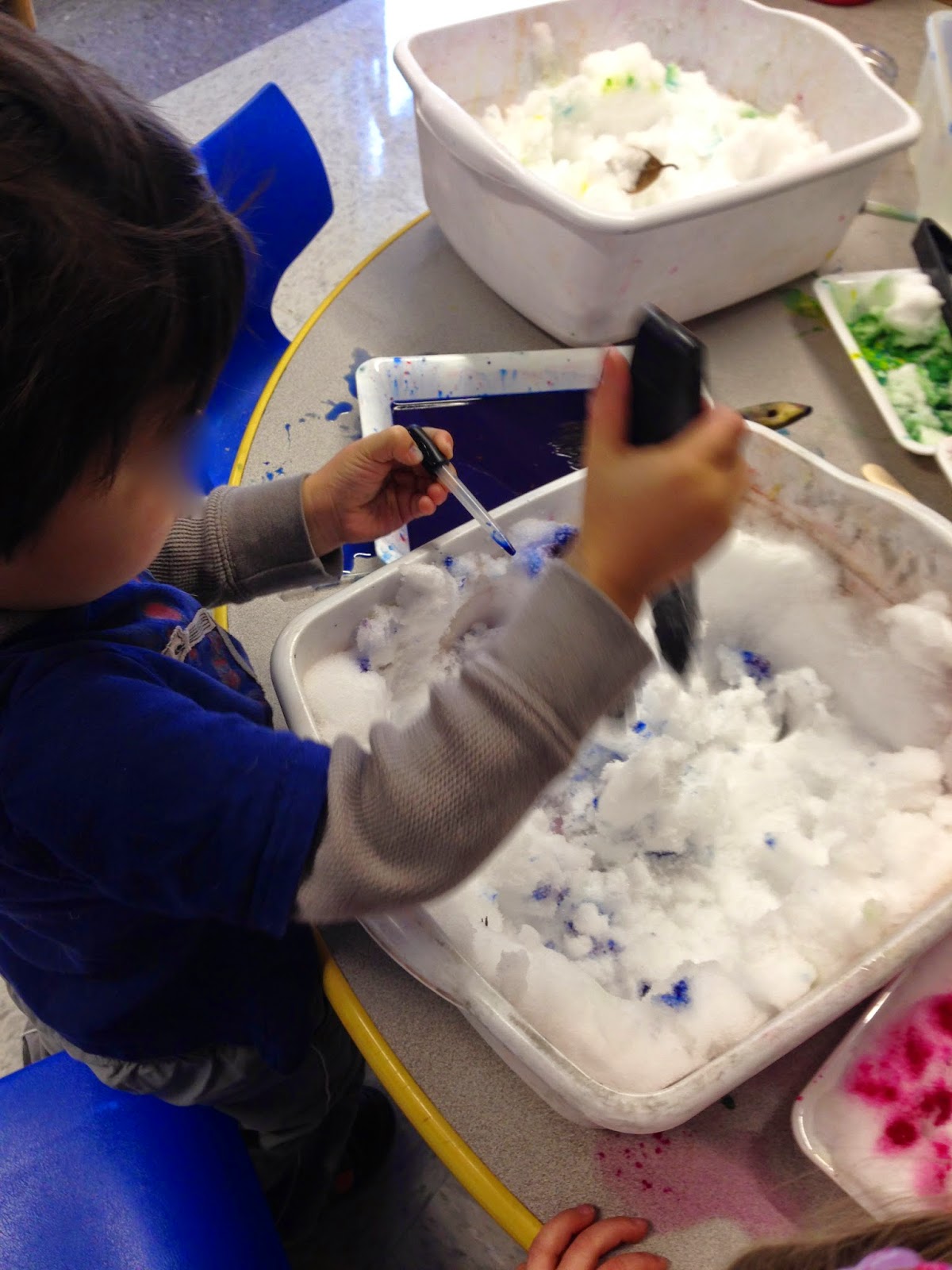
There were still three more large containers of snow…and these I added to the art table. The art table had been readied for a process art activity with found objects and paint. What if we used the paint and the found objects with snow? Why not? What might happen? Let's see!


I added a few extra tools - tongs, eyedroppers, tweezers, stirring sticks, spoons. I watered down the paint so that it might be useful with a dropper. Then I stepped back and watched the children explore...

immediately seeing


Excited preschoolers,
touching and squeezing the snow
filling eye droppers with paint, squeezing paint onto the snow
making dots, speckles on the snow
adding spoonfuls of snow into the paint
picking up snow with tongs
I love pink
I love purple
I love blue


Curious preschoolers,
dropping found objects in the snow
retrieving them with tongs
stirring them into the snow
dropping found objects into the paint
adding in more snow, to the paint
I'm making soup
I'm making spaghetti
Look! I got it all gone!


Focused preschoolers,
picking up tongs full of snow,
plopping the snow into the paint,
watching, watching, watching
as the paint moved up the snow ball,
the snow slowly filling with paint color
not melting but growing in color,
Stirring, stirring, stirring
meticulously removing every bit of snow from the containers
We are making snow!
It's turning to dark red
My snow is all pink
This is cold


Feverish preschoolers,
rapid questions, incessant demands
I need tongs!
What about tweezers?
I need another tray!
I need more water!
I need a clean squeeze thing! 
I want pink, too! 
What are those? 
I need something to mix!
Where did you get that?
I need a spoon!


Alert, excited, restless, engaged.


Me,
I was the guide on the side,
moving quickly to support them,
all things at once,
taking pictures,
making notes,
asking questions,
pointing them towards supplies,
encouraging them to resolve problems themselves
Where are they kept?
Has anyone seen where those are kept?
Where did we put them?
What just happened when you did that?! Wow!
What if you ask a friend where she got hers?
How might you get the paint out of the eyedropper?
What happens to the snow when you do that?
Did you ask her if you can have some?
Where might we get water?
Will that fit in there?
What happens to the paint when you put snow in it?
What do you think will happen?

I, too, was alert, excited, restless, engaged.

This is my favorite kind of centers work!

And it sure helped me to forget about that horrid commute.


Tuesday, August 5, 2014

Tuesday SOL What about technology?


This is a Tuesday "Slice of Life" for Two Writing Teachers. Check out their website for lots more reflections on teaching.

*******


What are the signs of an excellent technology program at the preschool level?
Lots of iPads?
Computers?
Whiteboards?

Or is it about providing an environment that is rich with time, space, freedom, and possibility?

Children building structures and wondering, what makes this strong, sound, sturdy?


Children learning to use a variety of tools?


Children exploring mixtures and processes and wondering, why did that happen?


Children planning a project, sharing the resources, working together, showing respect for one another's work?


Children moving and manipulating objects and wondering, what just happened?


Children investigating how things work and wondering, how might I make it faster, longer, bigger, better?


Children working with odds and ends, having access to ample materials, and wondering, what might this be? 


Children thinking with their hands and wondering, would it be possible to create something all new?


Children designing and creating devices and wondering, how might I make it do that? 


Engineering - Can you create a sculpture that moves?
Engineering - creating a bridge that supports several toy elephants

Engineering - designing a boat that floats


Children exploring the world through play, making interesting things happen, and challenging themselves to new limits?


Merriam-Webster defines technology as the use of science to invent useful things or to solve problems.  Preschoolers know - instinctively - the best materials for this scientific work. Just watch them at play in the classroom!