Showing posts with label self-regulation. Show all posts

Friday, May 31, 2013

Having trouble with their emotions? Wait a moment.

We recently had a day where all I could do was shake my head.

We rallied the children to go outside for a walk,
all the while, one tenacious child complained about going, because
she was not dressed for the weather...
although the day before had been in the high 80s, this day was in the low 60s, cloudy, with a continued breeze. This is spring in Washington, DC, varying, one day to the next.

Thus, one day, shorts, next day, jeans.

However - not for this little one.
For her, rules and order are required - if shorts yesterday, then shorts today.

She refused to put on the light jacket that her mother had hung in her cubby.
[There's a classic preschooler perspective - I'm not wrong; it is the weather that is wrong.]

I knew this was going to be a difficult walk.

We headed outside for our daily walk, all the same.
This little one would suffer the natural consequence of not dressing properly.
(Being a bit of a softie, I planned to shorten the walk.)

We stepped outside the school and her tantrum accelerated.
Here, outside in the air, was proof that it was chilly.
Why walk and work up a sweat when one could cry and yell?

Sharde, our beloved teaching assistant, took this child aside and worked one-on-one with her, challenging her to see how several classmates were also wearing shorts and not complaining.
"Let's all be together, one community. We'll warm up as we walk. It's not so bad out here."

I let Sharde work with her while I continued to lead the line away from the school.

The children were more or less happy with the walk when all of a sudden, as luck would have it, it began to drizzle.

Yes, it was no longer just cloudy, windy, and cool, but let's have some continual drizzle, too.
This was turning into Alexander and the Terrible, Horrible, No Good, Very Bad Day.
Even for the teachers!

Now, it wasn't just the one child falling apart.

Many children were complaining.
I heard a chorus, "Ms. Ingram, Ms. Ingram! It's too rainy! We need to go back!"

I turned to the two line leaders -
"What should we do? Turn around and get back to class and have a dance party? [we needed exercise] Or stay on our walk, because this rain is light?"

To my surprise and amusement, the two leaders chose different options.

[What a day! What strong and different feelings this class has, today!]

I again gave the decision back to them.

"You'll need to discuss this together and come to the same decision."

Back and forth, the two children bickered. "Go back!" "No, walk!"
I studied the line leaders.
One was a first-born, used to calling the shots, "Go back!".
The other was a second-born, relishing the position of opposite, "No, let's walk!!".
No compromise in sight.

The children behind the leaders grew louder with complaints - "Let's go back! It's raining too much! Let's turn around!" 

The drizzle and wind increased - or was it just the complaining?
Ugh. What a disaster this walk was turning into. 
The child in the back with the teaching assistant was howling in pain and frustration. 
All the children were yelling.

I bent down to talk to the leaders -
"It seems like everyone is very unhappy. I'm going to insist we go with the majority feeling - let's go back to school."
The sweet second-born - who had been so adamant that we continue walking - quickly agreed, as if it had been a non-issue for him all along, "Ok, Ms. Ingram! Let's go back!". 

I turned the line around,
only to have the entire second grade class pour out of the school to the front entrance area,
holding a large butterfly cage.

"What are you doing?," I asked.
All my preschoolers - noticing the butterfly cage - quieted down to hear the answer:

"We are releasing our butterflies today. We have thirty butterflies! Would you like to watch?"

We were almost back inside the school.

It was still drizzling.
It was still cloudy and breezy.
It was still cold.

But no one was crying or yelling anymore.

The Big Cats stood and stared, in awe, as these lovely butterflies were released into the air.
Butterflies floating into the sky,
some wandering onto shoulders, hair, even outstretched hands of these enthralled preschoolers.
Big smiles on all faces.

The earlier misery was completely forgotten.


What a great walk we had!
We saw butterflies!

Sunday, March 24, 2013

SOLSC #24 Shall I get the broom?


Two Writing TeachersSlice of Life Story Challenge (SOLSC)


This photo makes me chuckle.

I'm never quite sure if the mess from the sensory table - 
in this case, birdseed on the floor - 
occurs by accident or on purpose.
My preschoolers love these little brooms and dustpans.
They love that they are expected to clean up the mess.
It is a time-consuming process,
sweeping up birdseed,
when you are only three or four years old.
But, like anything else,
much more fun with a friend.

Friday, March 15, 2013

SOLSC #15 Can you help me?


Two Writing TeachersSlice of Life Story Challenge (SOLSC)


My laugh for the day -

Breakfast. 
She comes over to me with a small ziploc bag of granola and asks me to close it.  

Without thinking, in my morning fog, I zip the bag closed without asking her to try first. (Preschoolers need to work on those fine motor skills and I'm usually pretty good at insisting that they try something before I step in and fix it.)

Then she sits back down and immediately says to her classmate, with big smile, "Will you open this for me?" and hands the newly-closed bag to her classmate. The classmate - the great opener of all lunch and breakfast things - says, "Oh, sure, I can do that for you!" and he does. He hands the now twice-opened bag back to her. She murmurs - "Oh, thank you!"

In an effort to encourage children to work things out themselves, we have the general rule,

"If you need help with something, ask a friend first."

We love this rule. We noticed right away how much the children like to show each other what they can do.  We love that there has been a reduction in automatically asking the teachers for help.

But this was a new twist - create something that you cannot do and ask a classmate for help?

Well, you can't get your classmate to help you if you don't have a problem.


Too funny. 

Wednesday, March 13, 2013

SOLSC #13 Heroes - What are you afraid of?


Two Writing TeachersSlice of Life Story Challenge (SOLSC)


At our morning gathering, I posed the question - 

What are you afraid of?

Their fears poured out - 

things with googly eyes
space aliens
rain
big thunderstorms
the lights going out
earthquakes
monsters and ghosts
things that can eat you up
the dark
dinosaurs and dragons
car crashes
bad dreams
noises at night


We stood in our "Archer" yoga pose and recited our bravery chant, as we slowly moved our "bow" from side to side:

I am brave.
I may get scared
but
I am courageous.
I am brave.


Let the dramatic play begin!  One by one, we acted out a hero's response to each of these scary things.  
  • We huddled together, standing straight, strong, with hand's on our hips, and said, "You don't scare me! I don't believe in ghosts! monsters! space aliens! You don't scare me!"  
  • We lay on the carpet, pretending it was our bed, and we started singing the ABC song when we heard a scary noise. We weren't scared at all anymore!
  • When the floor began an imaginary rumble, we thought of an earthquake and we ran beneath our tables to stay safe.
  • We imagined riding in our car and how to stay safe - Put on that seatbelt!  

I believe saying these scary ideas aloud and "walking through them," together, even if only in our imaginations, helps these preschoolers to face their fears.  Certainly, it is a whole lot of fun - playing together.


Tuesday, October 2, 2012

Wanna play a game?

[I've been a little inconsistent in recent weeks with my participation in Two Writing Teachers' Tuesday Slice of Life...but, today I have one to offer...here goes!]


***

This afternoon, I observed such a delightful interaction.

It was just about "going home time," a restless, uneven time of day when some children are in a post-nap fog and others are loud and wiggly.  I was wrestling some school newsletters into children's 'take home' folders when I overheard Ms. McConnell, our Teaching Assistant, say,

"Oh, sure, we could play a game of 'Duck, Duck, Goose' "

I looked over at her quickly; she had been reading a book aloud and now these seven or so children were positioned in a small circle on the gathering carpet.

Yikes, I thought, 'Duck, Duck, Goose?' - we can't possibly do that kind of running around in here...we don't have the space and these preschoolers don't have the self-control...it will end in mayhem...

But, as always, Ms. McConnell was thinking along the same lines as me...

She continued, "But, we're going to play it by some very special 'Big Cats' rules.  Here's how it works, when you tap a friend on the head for 'Goose,' you then gently lean down and offer that friend your hand, and then the two of you walk hand-in-hand around the circle until you get back to the place that your friend got up from...then you sit down in that spot, and your friend gets to say 'Duck, Duck, Goose'; here, let me demonstrate..."

What?, I thought, Would they play like this?

Time for some argument. "That's not the way you play  'Duck, Duck, Goose'," said Lukas.

"Well, it's not the typical way.  It's a new way, it's the 'Big Cats' way," explained Ms. McConnell.

"Why do we have to play like that?," asked Charlie.

"Because we are learning self-regulation," said Ms. McConnell.  By her voice, "self-regulation" sounded both exciting and desirous - this was definitely something the children wanted!

And so began the most delightful game of Duck, Duck, Goose that I have ever witnessed!  Over and over the children played, taking turns, tapping one another on the head, walking hand-in-hand around the circle with their new partner, big huge smiles on their faces.

Ah, the honest and simple enthusiasm of preschoolers - give us rules and we will follow, as long as we think it is a game.

Precious.

Sunday, February 5, 2012

Is there room for the unplanned in your schedule?


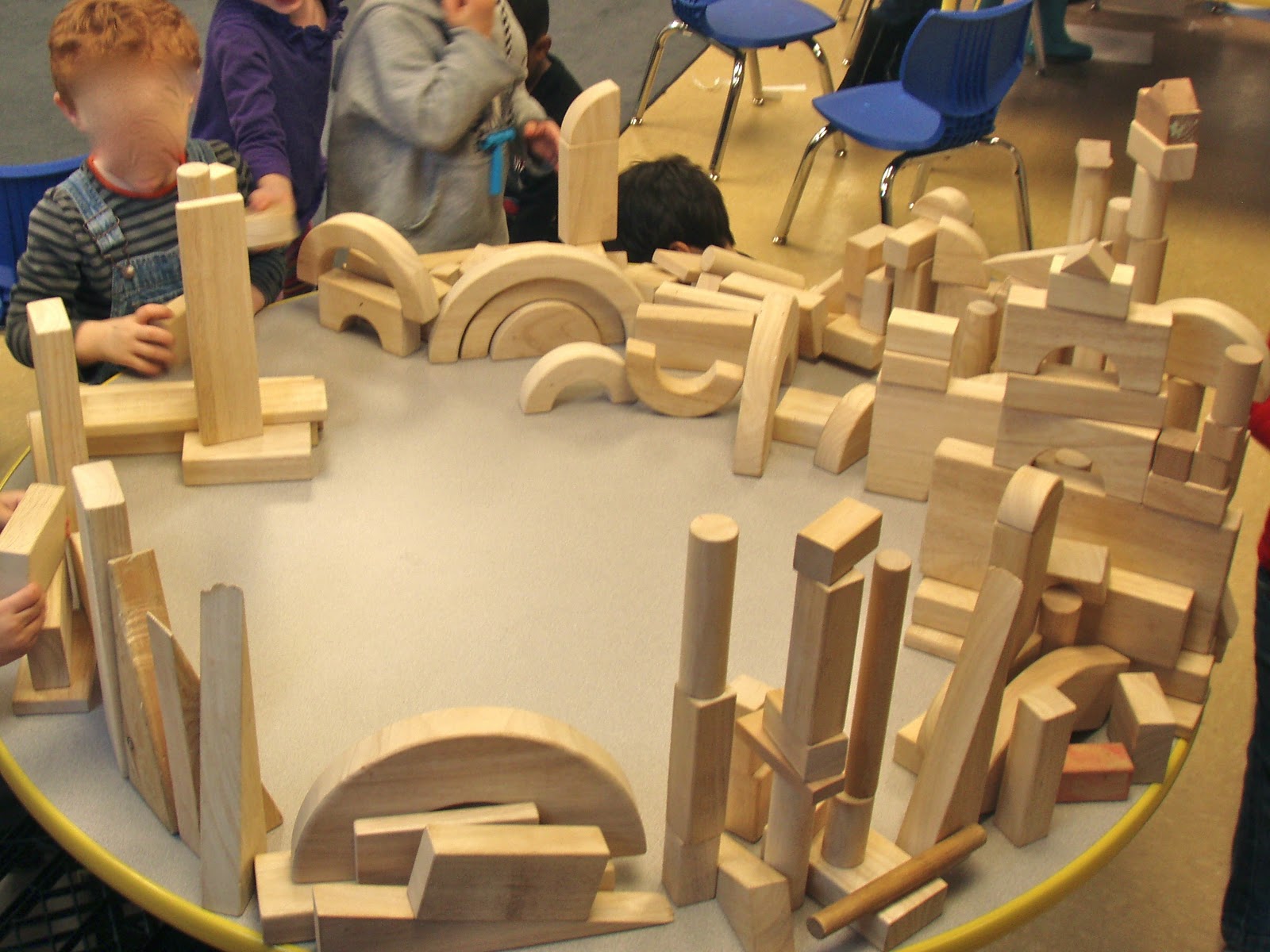
It was time for centers.  There were six special activities identified on our sign in board.
One boy had something else in mind.
And an empty round table to work on.
He carried a bin of wooden blocks to the table and worked quietly and determinedly by himself.


Within ten minutes, a couple classmates happen by.
"What are you building?"
 "I am building a city," he explains.


"I want to build with you!"
"Me, too!"
"We need more blocks," he explains.
And the two classmates went to get another bin of blocks.


With the three working so hard together, a city begins to appear.


And many more willing hands. And exclamations.
"We are building a city!"
"We can do it!"


"This is teamwork!"
"Look at this!  My city is growing!"
"It is our city! Our city!"
"It is going to be the biggest!"
"We need some help here!"
"We need more blocks!"


All our wooden blocks are now in play.


"Let's use these!"
The wooden blocks are used up.
The children race to get another bin, the plastic blocks.

And together,
and yet,
separately,
they add details to their own individual parts of the city.


Our entire 40 minute centers' time has been spent on this incredible city.  
Ten children working together at one once-empty round table.
Nearly half my class.
Self-propelled.

I want to let this work continue.
I want to honor it by letting it stay up.

Perhaps we can get back to it later in the day?
After playground? 
After lunch?
Yes, we'll use another table at lunch...


I walk over to the table and whisper,
"This is a fantastic city.  I like the work you are doing.  In a minute, we will put on the clean up song, but I was thinking..."
As if on cue, this table of preschoolers
acts as one
and topples the city,
sending all the blocks careening down,
over the table, onto the floor,
and one declares,
"Time to put them back in the bins! Clean up!"

Wow.  I didn't anticipate that.
I didn't anticipate any part of the entire forty minutes.
It was truly magical.
And these preschoolers
simply knew

they could create their city again.


Thursday, January 26, 2012

What about balls and ramps?

When the children returned to school after our winter break, I introduced a new center:  balls and ramps.  This idea is taken directly from my wonderful conference with Bev Bos this past summer, wherein she provides seemingly endless quantities of:

  • 1-inch cove moulding
  • wood blocks
  • cardboard tubes
  • other odds and ends for support beams and tunnels
and she lets the children explore these.  

I have long been a fan of cardboard tubes and balls, and I typically spend a good month or so exploring these with my preschoolers.  I loved the idea of extending this play with a variety of wood pieces - and I particularly liked the idea of creating a "discovery area" for this exploration, one which would be available to the children at their choosing.

Here's how Bev stored all the odds and ends for children to create ramps:


Here are two photos of the fun we teachers had with balls and ramps at Bev's conference this summer:


When I returned from the July conference, I asked my husband (Tony) if we had any such "1-inch cove moulding"... soon thereafter, he was in Atlanta visiting our brother-in-law, who just so happens to be a trim carpenter, and together they went through his workshop searching for pieces of wood moulding that might work with marbles, ping pong balls, or plastic golf balls.  Tony carried home a suitcase full of moulding for me to use in my classroom this year - and with that kind of effort, I won't quibble about it being larger than 1-inch.  The children are having a blast with these loose pieces, creating ramps throughout the classroom in all sorts of unusual ways.  Here are some photos with the preschool "Big Cats" this month:


Perhaps you are wondering what are the children learning with such play?  Well, let me help you:
  • Mathematics, including counting, quantifying, comparing and measuring, and understanding spatial relationships,
  • Cognitive skills, including attending and engaging, persistence, curiosity, motivation, predicting, and inventing,
  • Social emotional skills, including self-regulation, working with peers, and taking turns,
  • Science, including cause and effect and how things work, and
  • Love of learning!!
And here are some of the things I've overheard the children say, as they work with the balls and ramps:

"This is really working..."
"I have an even cooler idea...watch, it falls down, and goes like this..."
"What are you building, Sydney? May I build with you?"
"Ha, ha, ha, Lucca, that's great!  Whoa! Look! I did it, too!"
"Let me tell you how this works.  Here's how it goes. You have to drop it and bounce it, first."
"Let's finish this. Let's do it!"
"Did you see these?  Look, it opens!"
"What I wanted to do was add these two together...but...oh, here it goes!"

Yes, balls and ramps are here to stay.


Sunday, January 22, 2012

What to do with the Tiggers?

It happens so very quickly. He moves so very quickly. Highly-reactive, in a physical way! Today's example, he is carrying his lunch debris to the trash can; he pauses to look at the book that the Teaching Resident is reading to a small group of children. Another child moves into his line of vision. WHUMP! He throws an empty milk container at this child and then the rest of his trash. I am furious. There is milk and rice on the carpet. He just can't help himself; he never plans to react this way. If he sat and thought about it, he wouldn't do it. He is very sorry. It's just impulse. Throw! Shove! Hit! Smack!  


He sees I'm upset and he runs away, to the other side of the room.

Another day with my Tigger.

Wow.
They are exhausting to teach.
They are exhausting to parent.

Tiggers?

Yes, you know...as in A. A. Milne's Winnie the Pooh:
The wonderful thing about Tiggers
Is Tiggers are wonderful things
Their tops are made out of rubber
Their bottoms are made out of springs
They're bouncy, trouncy, flouncy, pouncy,
fun, fun, fun, fun, fun!
Tiggers.

For many teachers (and parents) this is truly "challenging behavior."

For many teachers (and parents) this is behavior that should be tamped down on.

I'm here to say:
Enough with the scolding! Let's seek to understand.


This is very, very common behavior.
Developmentally "within the range."
Not in the least surprising to me.
It is very common for three year old children
(often, but not always, boys)
to be highly physical, reactive, and impulsive.

In a much earlier blogpost, I described multiple intelligences as defined by Howard Gardner  (Linguistic, Logical-Mathematical, Spatial, Musical, Bodily-Kinesthetic, Naturalist, Interpersonal, and Intrapersonal).  Let's highlight one:

Bodily-Kinesthetic Intelligence. Breakfast table squirmers and the first on the playground, they pick up knowledge through bodily sensations. Athletically gifted, they show interest in sports, dance, acting - anything physical. They communicate using gestures and body language, like to act out their thoughts and are clever mimics. Occasionally they express their skills in crafts like woodworking or sewing. Without appropriate outlets, they may be labeled hyperactive. Learning comes with touching and moving. Motivate them through "role play, dramatic improvisation, creative movement and all kinds of physical activity," says Armstrong. Hands-on activities are their learning opportunities.

This year, I have several "Bodily-Kinesthetic Intellects" in my class.
They are perky and fun a lot of the time. But exhausting.
They learn with their bodies.
They discover with their bodies.
They hurt without realizing it.

What do I do in my classroom to support these students?

How do I discipline these physical, reactive, impulsive friends?

I honestly think that it is very likely that different temperaments, different intelligences require different discipline approaches.
No two children are exactly alike - why should our discipline be one rigid, unwavering way?
Tailor the discipline to the child.

With these "Tiggers", I try to:

  • let some of the small stuff go - no need to tamp down on every little mis-step
  • recognize and compliment when they show restraint, 
  • be a calm force in a reactive field (and forgive myself when I fail!),
  • minimize my words, 
  • lose my moralizing tone, 
  • take them by the hand and engage them in a moving, physical activity with a simple "Let's go..."
  • give them a physical outlet - a simple walk down the hall with me, or washing out paintbrushes, or wiping tables - before I speak to them about the "wrong-doing,
  • be present and quiet, alongside them - give them a chance to open up.

When the child is calm, and I am there beside him/her, I try to encourage reflection and amends.  Dan Hodgins  suggests that you help the child recognize the problem:

1. Ask, "what happened just before you hit Jamie?"
2. Restate what is the real problem, "Jamie took your truck and you are not done with it."
3. Help with solutions, "Jamie could ask first," "You could hit this box," or you could say, "This is mine and I'm not done yet."


I also find it helpful to teach my whole class about our different temperaments - and all the different ways that people show anger and frustration.  I teach children to give one another "wide berth" when one is frustrated or angry.  


Last, but not least, I try to step back and think about the individual child and the overall classroom experience that day - to reflect upon personal struggles the child might be having, plus, how many physical outlets I have provided, and how many "powerful things" I've allowed the children to do.  Am I providing an environment that allows children to learn self-regulation?  As Bev Bos, Michael Leeman, and Dan Hodgins emphasized in the "Good Stuff for Kids" conference this past summer:


the more "powerful" experiences that you give to children, the more self-regulation they acquire, and the less discipline issues that arise.

What does it mean to support or provide power for a preschooler? I know I already shared these from Bev, Michael, and Dan, but they are so important that I'm going to repeat them again here:

  • Jumping
  • Hammering and sawing (using real tools - with adult guidance)
  • Provide lots of physical space
  • Ziplines
  • A variety of movable objects
  • Ladders
  • Climbing walls
  • Allow children to raise their voices, to be louder than you want
  • Have a loud space (not just a calm down space)
  • Visual guidance (rather than adult voice)
  • Allow children to take things back and forth between centers/areas of the room
  • Give children choices; be flexible with them
  • Sword fighting with rolled-up newspapers
  • Ignore healthy "bullying" between children- such as - "Hey, go get that block for me" (retire the teacher's voice re: bossiness - especially if it's not an issue for the receiver)
  • Put out pretend fires
  • Construction - in as big space as possible (most workbenches are too small)
  • Crates for pulling and filling
  • Rough-housing and tumble play
  • Clay pounding
  • Singing
  • Dressups - especially capes
  • Tug of war
  • Arm wrestling
  • "London Bridge"
  • "Motorboat"
  • "Red Rover, Red Rover"
  • Boxes for kicking
  • Running
  • Handshaking!


Whew!  Yes, Tiggers can be challenging.
There's no single approach or technique that creates a perfect day every day.
Patience, understanding, and compassion are essential.

A final word of advice from Bev Bos:

When you are struggling with what to do, just gently hold the child's hand and look at it, study it. You'll know what to do, with your eyes on that sweet gentle hand.


Saturday, January 14, 2012

Happy Birthday, Martin Luther King!

I had been feeling quite timid about having a forthright discussion about Martin Luther King with my three year olds. We "threes" teachers had discussed how best to have this discussion with our young students.

Obviously, there was no need to go into graphic detail about the demonstrations, the violence, his assassination. Leave this to future years of schooling, a more appropriate developmental age.

At the same time, as I told my Teaching Resident, Martin Luther King should be a thread woven into the fabric of what we do in the classroom, supporting us, always present. His approach to resolving conflicts is the approach we have in our school. His standing up for justice, asserting himself, standing up for what is right is a skill I want to nurture in my students. I want them to question authority, to dare to challenge the norm - not simply to be oppositional, but because they are thoughtful, reflective people who seek fairness. I work to create a classroom environment where we have frequent discussions - at whole group time, with small groups of children, and one on one - about why we do things a certain way, how best to make make amends, whether something is right or wrong, what is fair, and what ideas do we have to make things better. I believe it is important for the children to see me make mistakes and to hear me apologize when I do something hurtful. It is essential to hear different opinions and ideas from one another and learn that is okay, and to learn to be respectful of our differences. All of these are me "weaving Dr. King into my daily program."

I am inspired by my colleague Tsitsi, our Pre-K teacher, who shared her lovely curriculum with me about Martin Luther King. Tsitsi experienced her daughter being the only African American in an early childhood program and since that time has made it her own personal goal to not let this discussion be ignored or set aside. Using an anti-bias approach, she is forthright about our nation's history (at a developmental appropriate level), and encourages discussions about differences and similarities, what is just, and how to resolve conflicts. When I popped into her room last week, the children were creating a large school bus with multicultural faces at all windows of the bus - a bus for everyone. Delightful.

Tsitsi's insightful approach fueled me. For our read aloud yesterday, I read Happy Birthday, Martin Luther King by Jean Marzollo and illustrated by J. Brian Pinkney and asked them to think about why is Martin Luther King a hero?

(There are many books for children about Martin Luther King - I loved the simple, direct writing by Jean Marzollo and I am particularly drawn to the artwork by J. Brian Pinkney. The beautiful illustrations are created with scratchboard and oil pastels.)

When I read about whites and blacks being separate - sitting in different parts of the bus, attending different schools - the children gave that part of the story an immediate "thumbs down" - as is our classroom ritual whenever we hear or see something that isn't right. When I read about this being the law, they looked at me very puzzled, not understanding. I had the sense that I was reading a fantastic tale from which their daily lives are much removed.

The children were delighted by J. Brian Pinkney's illustration of Dr. King's speech in Washington, D.C., at the Lincoln Memorial, showing the reflecting pool and the Washington Monument. One after another and all at once they exclaimed,

"I live there!"
"I live in Washington, D.C.!",
"I have been to the Washington Monument!"
"I know that place!"

Yes, three year olds are a very sweet and simple age. The world is oh so good.

I named Martin Luther King as a true hero, because he dared to speak up about things that were wrong, insisting that things needed to change. He challenged people to behave better. I emphasized that he never hurt anybody in trying to get what he wanted. I did a little bit of preaching,

"It's the same thing we do here in the Big Cats' classroom, " I said,
"We use our words, not our hands, when we are angry.
We speak up and tell our classmates, 'I don't like that.'
"

As our discussion concluded, one student exclaimed,
"Wow! And I thought superheroes always fly!"

Perhaps there are many different ways to fly.
I am soaring at how invisible the pain in our world is to these children.
They have families who love them dearly and
classrooms where they are safe, nourished, trusted, and challenged.

May this provide the strong foundation for them to be future leaders who seek to solve disparities in our world.

Tuesday, July 19, 2011

Why are you doing that?

A big part of my professional development this summer has involved reflecting about the way that I automatically do things as a teacher - and daring myself to change when necessary.

A big part of mentoring new teachers involves this same intellectual stretching -
daring to ask them:

Why did you do it that way?
Was it successful? What were its drawbacks?
Is that what you hoped to accomplish?
Is there another approach?


Teaching necessarily involves being open to learning new approaches, taking risks in the classroom, and revising again. It is essential to have time and space for reflection about our teaching. It is so wonderful when teachers can be mirrors to one another, helping each other to reflect and to look at things differently.


A group of new teachers worked with a group of five year olds to create an "emotional continuum" - encouraging the children to think about their emotions, all the different things they feel. This was a fun, engaging, and creative curriculum idea - a lovely exercise at the beginning of a school year, or, in this case, summer program, to help young children get in touch with the range of their emotions and how we all feel differently at different times.

The group quickly came up with a few "tried and true" emotions -

Yes, happy.
Of course, angry.
Sometimes, scared.
Frustrated.
Excited.
Sleepy.


The teachers were thrown a few "curve balls," when a free-thinking five year old said:

"I feel excitire." She wrote the word on the board for us, and explained that excitire was "when you are so excited you feel tired."

Another five year old suggested:
"I feel Chicken Wings!" and began to flap his arms as wings and move furiously about the room. We learned that Chicken Wings is a particular kind of silly.

Still another, feeding off of this creative surge in the brainstorming, added:
"I feel ezcere;" he, too, wrote the word on the board for us, and explained that ezcere means "you are trying to do something and really focused."


Everyone had a lot of fun dramatizing each of these emotions - both the "tried and true," familiar ones and the brand new creations by the free-thinkers. They acted them out as a class and I took photos of everyone - both students and teachers - "being" that emotion.

The next day, I came into the classroom to observe the new teachers. I saw that the emotion photos were printed out and posted along the meeting rug area - lovely! Throughout the summer program, the children will have a daily ritual of "checking in" in the morning ( and anytime they feel like it during the day) and then placing a clothespin (labelled with their name) on the emotion they are feeling.

But, on closer inspection, I saw:

the three "curve ball" emotions were not included in the emotion continuum.
What?
I was puzzled.
I knew that we dramatized these wild creations - I remembered taking the photos myself.

Ahhh...I see...
Perhaps these made up words aren't good enough?


How often do we do this to children - trump their ideas with our adult beliefs?
How often do we ignore their playfulness or wit, in the interest of time? In the interest of accomplishing our own goals?
What is the value of including and running with children's own ideas in our curriculum planning?
Why might it be difficult to include children's ideas?
How flexible is the curriculum plan? Is there room for children's own input?
How might children's engagement in the topic be affected?
What is your intention as teacher - to fill children with your wisdom or to light a spark within, so that they seek to fill themselves?
What changes can you make in your planning so that children's ideas are more welcome?


This became a teachable moment for the new teachers about the value of using authentic student work. It was also a teachable moment for me, as I realized how suddenly and unexpectedly good teaching can be undone or stalled because we are focusing on time and efficiency, "getting the curriculum across."

Teachers need
time to reflect, and
colleagues who act like mirrors.

Why did you do it that way?
Was it successful? What were its drawbacks?
Is that what you hoped to accomplish?
Is there another approach?

Monday, February 21, 2011

What to do about squabbling?

The setting:

I am observing a first year teacher, in a classroom full of three and four year olds.

Children are playing in centers.
There is a post office set up in dramatic play, and there are rules:

- Only three children allowed to play in this center.
- Two children are customers, one is the post office employee.
- Only one costume, the post office employee, with hat, jacket, and mailbag.

Do you predict there will be some squabbling?

First off, more than three children wanted into this dramatic play. The teacher patiently reminded them to look at the center "sign in" and count how many students had already signed in.
Was there room for another person?
No, there was not.


Meanwhile, at the post office -

All three children wanted to carry the mail bag.
All three children wanted to wear the jacket.
All three wanted the hat.
They seemed to know instinctively that the best role was that of the post office employee.
What fun it was to stand behind the counter, selling stamps, envelopes, boxes.
What fun it was to walk around the classroom and deliver mail.


My initial reaction - why aren't there costumes for every child? You can make a very strong case for having multiples of everything - so that all the children in the center can have the choice of dressing up, being in character. Three and four year olds love to dress up! And they are wonderful actors, throwing themselves into dramatic roles. If you don't want to have 3 post office employees, how about special signature costumes for customers - special hats, coats, perhaps a briefcase or purse?

On the other hand, if you - the adult - are ready to provide guidance, you can make a very strong case for having less costumes and helping children with the negotiations. Yes, squabbles over who gets what are life with preschoolers. But, an important part of their learning is about how to get along.
How do you actually learn how to get along if you never have conflict?
How to say "I'm sorry."
How to say "May I have that when you are through?"
Learning to speak up when someone takes something from you without asking.

I watched this new teacher perform beautifully with this situation....

She throws herself into the role of customer, alongside the three children.
She turns to Child #1 behind the counter, who is dressed in the jacket,
"I have a letter to be mailed, I need to buy some stamps."

[And turning to Child #2, potential customer, added,
"I'll let him ring up my stamps, first." ]

Back to Child One, the post office employee,
"May I buy a box from you?"

[And turning back to the customer, Child #2,
"Hmm, who should I send this letter to?
"]

Child #3 is wearing both the hat and the mailbag, and is getting ready to leave the center with a fistful of envelopes, for delivery.
I think to myself, Have the children "organically" decided to have more than one post office employee? I love this!

Not for long. Child #1 marches over to Child #3 and grabs the mail bag and quickly puts it on his friend, Child #2, transforming him from customer to employee.

Teacher sees the instantaneous long face of Child #3 and also observes him walk away, dejected.

"Whoa," she says to Child #3, scurrying to his side, putting her arm around him, "Did you want to give him that mail bag?" He shakes his head "No." "Well, let's go tell him. You don't have to give away something you are still playing with. Let's talk to [Child #1], you and me together."

She helps the two children talk together, and, simultaneously, Child #2 (the one who is now wearing the mail bag because his friend gave it to him) is listening to the discussion and gives the mail bag back to its original owner - "You can have this. I don't need it."

Two of the three children are very happy - but Child #1 had another script in mind for his play - he angrily takes the mail bag again and returns it to his friend, Child #2.

Teacher's interjects, arms around all three now sad children - and says pointedly to Child #1, "Now, your friends have talked about this. [Child #3] is using the mail bag. I see you have on the jacket. What if we took the jacket and gave it to someone else without asking? Would that make you feel good or sad?"

"Sad," he whispers. He is safe and comforted by his teacher's arm around him.

She continues, "If you had the mail bag on you shoulder, would you want someone to take it?"

It is as if a lightbulb goes off - Child #1 exclaims, "No, no, I don't want them to take from me!"

And then the teacher reframed the play for the children - pointing out a new opportunity, "So, you might all work in the post office, delivering letters or selling stamps. It works out nicely."


Yes, it really does work out nicely. Such nice modeling and intervention by this teacher, patiently and painstakingly delivered.

These are small but important moments in children's lives. It matters that children are heard - it matters that we take the time to help them use their voices, to be in community with one another - to not simply demand friends to do things your way, to not simply give up and walk away.


Honestly, when you see the growth and understand the possibilities - the evidence of empathy, the movement away from hitting, you may find yourself intentionally setting up centers with only a few things - forcing the sharing. Think of the learning possibilities!


"You can do no great things, only small things with great love."
- Mother Theresa.

Thursday, September 16, 2010

What is developmental discipline?

I just finished reading an inspirational book about one elementary school teacher's attempt to change the way she disciplined her students: Learning to Trust: Transforming Difficult Elementary Classrooms Through Developmental Discipline by Marilyn Watson, in collaboration with Laura Ecken. This book is basically a case-study, detailing enormous work by the teacher to create a more collaborative learning environment. I will not attempt to write a synopsis or review of the book, though here is an excellent one from the Harvard Educational Review.

Let me simply offer you Marilyn Watson's own words, in the book's Epilogue, for your reflection:

Teaching conditions vary greatly across the country and even across a single district. Each person's solution to eliminating or ameliorating any systemic barriers to building nurturing relationships with students will differ. However you manage to do it, increasing your time with your students, leveling with them, and enlisting their support will be keys to your success. In addition, it will be crucial to find supportive colleagues wherever you can, whether in the principal, other teachers, parents, community members, or nearby university faculty.

Remember that beliefs about children and their motivations run deep and are often unexamined. We have incorporated deep within us such conflicting messages as "Children are innocent and loving" and "If you give them an inch they'll take a mile."

Likewise, many of our emotional and behavioral responses to children are not reasoned but automatic; we become angry or hurt when children violate our trust, and we want to punish them when they defy us or persistently disobey. We are not accustomed to thinking of children as biologically designed to seek adult guidance and care or as having their own particular working models of adults, relationships, and the world. Nor are we accustomed to teaching our students to trust, to regulate their emotions, or to guide their behavior by reflection and self-talk.

Adopting a developmental approach to teaching and discipline often involves changing how we think and feel about children, how we interact with them, and what we are trying to teach them. Such profound changes happen slowly, and as they are happening they lead to a good deal of uncertainty, requiring reflection and patience. Allow yourself mistakes; be confident in your goodwill and competence, your ability to reflect on your practice, and your openness to learning from your mistakes. Give yourself time, and be sure to keep your eye on the many successes, both large and small, that happen along the way. As you struggle with the inevitable problems, uncertainties, and setbacks, these successes will provide the most sustaining support of all.

Tuesday, July 27, 2010

How to help children feel better?


One more blog with the theme of "bridges between school and home...."

Both preschool teachers and parents are only too familiar with the way children's behavior can fall apart, sometimes within seconds. Worse yet, sometimes children just have a bleak mood for the day. As the responsible adult, you have to deal with children who are whining, clinging, crying, yelling, or just plain needy. How can you change the mood? How can you get children to relax, take a deep breath, "chill"? Is there any way to teach children to self-soothe, calm down, or decompress?

What if you are in a bad mood, and you simply can't deal with your child's?

I received lots of great information on this during my teacher certification course at Montgomery County Childcare Association's Teacher Training Institute. My first day of class - which ended up being cancelled - was September 11, 2001. As the class continued that fall, Jacky Howell and Debbie Lebo reminded us repeatly about how important it is to keep young children cushioned and safe from our adult world problems. Many of my favorite techniques "to brighten the mood" are from this training:


Dance Party - put on your favorite dance music, announce "We need a Dance Party!," and begin boogying. All the more fun if you have special scarves for you and your child to hold onto as you sway to the music. I have changed the sour mood in my class with one stanza of Van Morrison's "Moon Dance" - children love to dance. The key is to put on music YOU enjoy, so that you will put your happiest heart into it.


No, Yes, Maybe (courtesy Debbie Lebo) - this is a very silly chant that can be done while sitting or standing and loosens up your neck and shoulder muscles. It goes as follows:

No, No, No!
(shake your head from side to side, and give a stern face)
Yes, Yes, Yes!
(nod your head up and down, and give a smiling, delighted face)
I don't know, I don't know, I don't know!
(roll your shoulders, up down, and give a perplexed face)

You can chant this over and over, faster and faster, and I promise, children will start laughing (and, hopefully, start mirroring your movements, letting their bodies relax).

Pretend Lotion (courtesy Debbie Lebo) - Here's one for you to practice your dramatic skills:

Open an imaginary bottle of magical relaxing lotion.
Squeeze some into the child's hands.
Put some on your hands, too.
Then, pretend to rub the lotion on your hands, arms, face, feet, and legs,
as the child mirrors your actions.
This is relaxing play!

Blow Bubbles - this childhood favorite, available at any dollar store, is always a hit. My colleague Michal recently shared a wonderful anecdote about the power of bubbles:

At a parenting workshop at a homeless shelter for young single mothers, Michal gave everyone a little gift of bubbles...later that evening (as told to Michal by the shelter's director), one mother, responding to her whiny, crying toddler, got out the new bubbles and blew them over the child's head, without saying a word. A magical mood-changing moment occurred: the toddler began to squeal with delight and the mother smiled and laughed.


Most preschool teachers keep bubbles at the ready in our curriculum cabinets - for the same kind of mood improvement. Bubbles are great!

Debbie Lebo notes how a sweet, soft hug or touch can improve a child's mood. She suggests these (and other) loving activities for one-on-one, adult with child:

Baby in the Bed:

Now's the time to go to sleep
(Child holds up one finger for "baby")
Put the baby in the bed
(Child lays finger on your open palm)
Cover the baby in the bed
(Fold your palm gently)
And kiss the baby goodnight
(Kiss child's finger in your hand)

Spiders:

Spiders crawling up your back
(Run fingers up the child's back)
Spiders crawling down your back
(Run fingers down)
Three big bumps!
(Touch fist gently 3 times on the child's back)
Cool breeze
(Blow on the back of the child's neck)
Warm squeeze
(Hug the child's shoulders)
Now you've got the chillies
(Tickle once around waist)

Don't forget the easiest mood-changer of all: go outside. If you are cooped up inside, take your child out and run, run, run around. Even if the weather is yucky! A few moments outdoors can do wonders for everybody.

These are just a few of my favorite mood-changers. There are many, many more. I hope you will give them a try!

Tuesday, July 20, 2010

Why tell children the schedule?


Let me continue on this topic of "bridges between home and school" - things teachers do at school that families could continue doing at home, making life with preschoolers a little easier or perhaps even more fun. Today I want to explain the thinking behind "the daily schedule" - why teachers always provide visuals of the day's routine; more specifically, why they always tell children where they are going next. Simply put: children need to know where they are going!

At the Addressing Challenging Behavior Conference this past March, Ron Roybal, speaking about Lessons Learned About Including Children with Autism, pointed out that "routines within routines are key to predictability for all children." He maintains that - in any activity, at any time of day, children behave best when they know what to expect, i.e.:


1. What am I doing now?
2. How do I know I’m making progress?
3. How do I know when I’m finished?
4. What comes next?

You will have much less challenging behavior from your child if you help him/her to understand the routine, the schedule.

(Lest you question the need to do this, let me ask you - are you comfortable in meetings where there are no agendas handed out? Most of us do better when we know where we are headed.)

The younger the child, the more this routine needs to be conveyed in ways that use a variety of senses - visuals such as hand signals, facial expressions, or pictures; or sounds such as a special clap or song; or even physical techniques such as standing and stretching, putting hands on your ears, or other fun movements.


I want to share with you a chart I created years ago for my then 4 yr. old Wade, who was sandwiched between his infant brother Bryce and 6 yr. old Keith. I was having a dickens of a time getting them all out the door in the morning, to get Keith to elementary school on time. My dear friend Carol (a teacher!) suggested creating this chart for him...when he finished a task, he moved a simple "velcro dot" to the DONE column. I listed five tasks:

1. Eat breakfast
2. Wash face and brush teeth
3. Make bed
4. Get dressed
5. Put on socks and shoes

The chart was not particularly pretty, but, boy, was it effective. The result was - almost instantaneously - no more grumbling, no more pleading, no more stress getting out the door - seriously! I couldn't believe it. (Though, in the interest of full disclosure, I have absolutely no memory of any of my boys making their bed on a regular basis - I'm sure my expectations for this were pretty low.)

Perhaps my delight in creating this was what led me to consider becoming a teacher myself? Yes, perhaps. However, the result pretty much sealed the deal - I began to see that the best way to teach a child was to try to think like the child, to see it from their perspective, and then - help them break down a daunting big thing into smaller chunks.

I began to see the power in having an inanimate object set the rules for our family! Yes, that's a joke - but there's a kernel of truth in it: I had removed "Mom" from the equation, I had taken the emotional out of the morning routine. 4 year old Wade tried to complete the tasks that were set out in front of him for their sake, for his own sake. He understood where he was headed.

The next time you need to do something or go somewhere and you find that your children are falling apart or resisting (and you are stressing out), I hope you'll consider how much information your children have. Ask yourself if you've told them where they are headed, what they'll be doing, how long before they leave, how they will know when it's time to leave, and other aspects of the schedule.


Keep your description simple, succinct, and (as always) calm. I use alot of visuals in my classroom. I am a big fan of pointing at pictures and saying "Hmmm, what do we have to do next?" or "What does this tell us?" I also use sounds - a chime, a rainstick, or a special drum to indicate I have something to say or that something is ending - "When you hear the drum, it will be time to...."


Honestly, to provide children this insight and help with routines and schedule is to show them the same respect we accord ourselves.

Tuesday, July 6, 2010

Circle time is a trick of the trade?

Every day at preschool, teachers gather the entire class together for some fun community time: circle time. Often, the schedule for the day is presented, a special book is read, fingerplays and songs are sung; there may perhaps be a game or a question of the day to discuss; there is, always, lots of conversation. Different teachers have their own rhythms, routines, and preferences with this gathering time. Most teachers build in a great deal of flexibility in their circle time plans, because every day brings surprises due to different moods (both children and adults), unexpected interruptions, or just because.

I think circle time builds the foundation for my class as a community. It is so important to simply gather together, to get to know each other, to learn the give and take of people together.

Circle time (or, more accurately phrased, "gathering time") is another bridge between home and preschool - something teachers do at school that families could continue doing at home.

I sometimes hear parents say, "Oh, she's so little, we would never make her sit with the family." Or, vice versa, when the child in my class is the oldest in the family, parents might say, "I'm really frustrated at how she won't sit still with us, she gets down from the table."

Remember, if your child's teacher is gathering the children every day, your little one is able to sit, wait, listen, and talk together at home, too. This is an expectation that is important to repeat at home, helping your child with his/her self-control. That being said, keep in mind your child's age, temperament, mood, and any other extenuating factor. Help them be successful and don't expect it to be a success every single day.

Here are some ideas to help it be more successful for your little one -

- let them hold something in their hands,
- let them have a job or task (for example, help set up, hand out things, or call everyone together) ,
- let them have a shorter participation time,
- let them sit and play with something else, quietly, alongside the gathering (they'll still be listening!).

All you really need to do is establish the ritual - create the opportunity to come together. A great time to get-together is a meal that everyone shares, but there may be another ritual time, for example, book reading or storytelling or an evening game before bedtime. When you gather together, be sure to give everyone a chance to talk (and everyone learns to listen to one another). Make it a daily event! It is important to gather together as a family. You will never regret laying the groundwork for family discussions when your children are very young - and it will serve you well as your children grow.

Another gathering time ritual that you should consider introducing while your children are young is the "Family Meeting." The idea of these weekly sessions was introduced by psychiatrists Alfred Adler and Rudolf Dreikurs, who emphasized authoritative parenting versus the extremes of autocratic or permissive parenting. There is a lot of info about family meetings available on the internet (see the links I have provided) and there are many excellent parenting classes that offer training about this important ritual. I took a class through my local Y many years ago. These meetings provide a calm forum for discussing the family schedule, upcoming events, possible conflicts, hopes, and expectations. Begin this ritual when your children are young - when your children want nothing more than your smile and attention - so that it is routine and entrenched when they are teenagers. Remember,

Little kids, little problems, big kids, big problems.

Here's hoping circle time is a "trick of the trade" that you might consider using at home!

Tuesday, June 22, 2010

How to teach empathy?

This morning as I went out for a jog, I was sad to see a rabbit dead in the road, run over by a car. Next to the rabbit, sitting right on the curb, some three feet away, was another rabbit...perhaps his partner, certainly his friend...present, near, sitting with the dead rabbit. I was moved to tears. I walked respectfully by, thinking, "Wow, even our dear little animal friends have empathy. Feel pain for others. Feel loss."

I believe we are all born with empathy, with the possibility of being empathic.


I also wonder if there is a window in which, developmentally, this trait must be "solidified" in order to be intrinsic to one's being, in order to be lived out rather than stifled or shut out. If there is such a window, I am certain it is the early childhood years.


I have met (and heard about) many people that seem to not be empathic. Pick up a newspaper and read the stories and you will see lots of ugly behavior - defensive, self-focused, embittered, detached, uncaring, bullying.

Parents and teachers of preschoolers often ask me - Why does he hit everyone? Why does she boss her friends around? Is he a bully? How can I stop her from being a bully? At a training workshop last fall, one teacher surmised about her 4 year old student's frustrating behavior - "he's just trying to get my goat, looking for attention." I'm sorry, but I just do not accept that kind of negative thinking. I think it is our job as educators and parents to teach empathy, to provide a positive learning environment where children's feelings can be explored and self-regulation and understanding can begin.


How do we ensure that our children will grow with softer hearts? How do we teach this, early on?

Simply put, our home lives and childcare programs must demonstrate and reflect empathy. Teaching a child to be empathic will be easy and painless if they are surrounded with an empathic world - with loved ones who reach out to help those in need, modeling the appropriate way; with adults who speak kindly and with understanding, encouraging and laying the groundwork for children to get along together; with parents and caregivers who don't get angry, defensive, and presumptuous when a child misbehaves, but who stay calm while setting higher expectations for how behavior should be.


At that wonderful "Friendship Skills" training I attended back in March (see my 24 March 2010 blog post ), Phil Strain noted that one of the most important qualities in any friendship is "reciprocity" - the ability to give to others when you aren't necessarily getting something in return...you have trust in your relationship, you know there is mutual give and take. Phil Strain noted what a difficult concept this is to get across to young children.

Realistically, you don't tackle this as a one-time subject unit - "Today, children, we are going to learn about empathy." Instead, learning opportunities must be woven into the day, day in, day out.


Here are a handful of ideas:

- One trick I employ is simple mantras, referencing a higher moral ground:

"Everyone is safe and loved here."
"It is our tradition to show kindness and respect with one another."
"We are gentle with our hands. We are kind to others."
"It's not our tradition to yell."
"Let's hear what she has to say. It is right to listen to others and hear what they are thinking."


- In my classroom, I have a job of "Comforter" - this pair of children is responsible for
bringing our class boo-boo bear to any child that is hurt or crying during the morning. (Three year olds are "ambulance chasers," running up to see...not necessarily to care! I'm trying to teach them the next step in a healthy relationship.)


- At circle time, we often play the game "Give a Compliment," where, one at a time, each child rolls a ball to a friend across the circle and gives a compliment about that person. Learning what compliments are and how to give them is a definite skill! (See Responsive Classroom for this and other great games and activities that help children learn to share and appreciate one another.)

- When I read storybooks, I often ask the children what they think other characters are feeling - much like Jon Sciezka's The True Story of the Three Little Pigs by A. Wolf. These can be wonderful lunch time and circle time discussions - what do you think Mommy Owl was thinking when she was gone from her Owl Babies? Or, how do you think Daddy felt when he couldn't understand what his daughter Trixie wanted in Knuffle Bunny? The goal here is to stretch children to consider another perspective.


- Perhaps most importantly, simply gather together with the children in your class or with your family...develop rituals and opportunities for loving, caring exchanges together. Let children see and hear what others are thinking, feeling, hoping, and believing - and to become part of their community.

These ideas are really too few in number. There are so many more things we adults could do to introduce empathy to children. As with all things early childhood, there is no easy, one-step answer...helping a child be empathic takes time and focus. What are some other ideas? I'd love to hear from you. This is a topic worth exploring further.